The copywriting landscape is shifting and there are the 3 copywriting trends you can’t afford to ignore anymore.
These are strategic shifts that you can implement now as they are already changing the way values-driven businesses write, sell, and show up online.
This is for heart-centered service providers, podcasters, coaches, and wellness practitioners who want marketing that converts without becoming a second full-time job.
I’m answering questions like:
- How do I stand out when everyone’s using AI?
- How do I get my content cited by ChatGPT, Perplexity, and Google AI?
- Where should AI fit in my marketing?
And I’m going to humble brag for sec. My predictions for 2025 and again for 2026 were spot on. So let me know if you think I can get right 3 years in a row with these marketing and copywriting trends.
- Hyperspecificity in Your Content and Copywriting Is Now A Must
Hyperspecific copy lets your ideal client recognize herself in one sentence, so everyone who clicks like you already know and understand them deeply.
What hyperspecificity looks like in real copywriting
In 2027, hyperspecificity lets people know exactly what they’re getting and the exact type of person who it’s for.
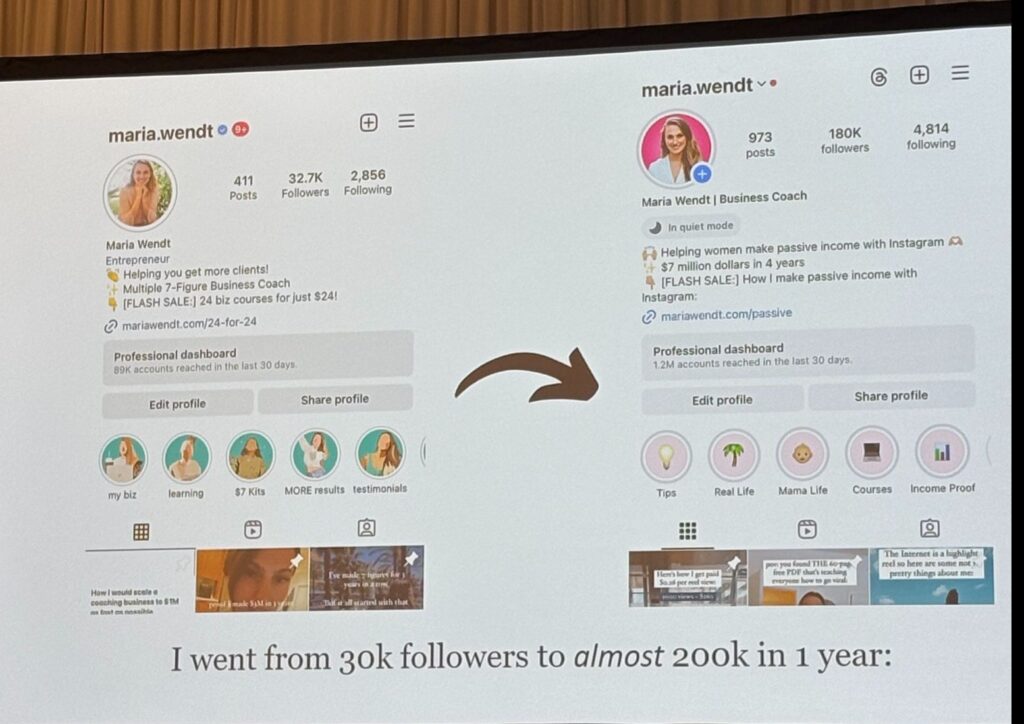
Maria Wendt’s Instagram bio before-and-after is a great example: What she does is crystal clear and the offer is high-intent, which is probably a big reason her conversion rates run higher than average. Every person who clicks has already self-identified.
How my clients are getting hyperspecific in their copywriting
- A gut health coach narrowed into a focus on constipation.
- A business and marketing coach became the networking queen.
- Physical therapy clinics shifted toward weekend warriors, with a focus on preventing injury.
- A luxury travel advisor chose to serve families of adult children. She could plan trips for anyone, and naming her people calls them in.
What is the one thing you want to be known for?
Copywriting Example: What this sounds like in women’s wellness
Picture a nutritionist whose homepage says, “I help women feel their best.” Now picture, “I help women in perimenopause plan simple weeknight meals around the energy they want for their days.” The second line names a season, a situation, and a desired outcome.
A pelvic health therapist could do the same by not just speaking to new moms, but get hyperspecific by talking to new moms returning to running or training for local race coming up.
- First-Hand Experience Content Will Rank Best In Google and AI Search
First-hand experience content ranks because the internet is flooded with AI-generated information, and search engines and AI platforms reward the expertise only a real person can show. This kind of content can be:
- Customer success stories
- Expert interviews
- Case studies
- Industry opinions
- Behind-the-scenes insights
Brands that share what they’ve have actually done will stand apart from generic content created just to rank. For a deeper look, listen to my conversation with Laura Jawad on SEO and content marketing strategy and my episode on website copywriting and Google algorithm updates.
Examples of what first-hand experience content can look like for wellness brands
- Imagine a postpartum doula who writes about the three questions she hears most from new moms and answers them in her own words.
- A women’s fitness studio owner who shares the story behind how she designs her classes.
- A perimenopause workout app shares case studies of women feeling stronger, more confident, and more capable.
Each piece carries a lived perspective that no one else can replicate.
Less polished content is more relatable. Let that be a relief! Real quotes from your audience and candid photos with a scrappy edit feels more relatable and like something you’d send a personal friend.
AI can summarize what is known. Only you can share what you have lived and experienced.
3. AI Is Here To Stay, But Not In Your Copywriting
This is specifically for personal brands that are over $1M annual.
AI’s place will stay more in the pre-writing stage:
- Advanced audience research
- Content gap analysis
- Predictive topic recommendations
If the goal of marketing is human connection, why are we delegating that to a robot? Those are the moments that we need to keep human. Natalie Ellis and Ryan Levesque on the BossBabe podcast agree with keeping AI in your backend systems and processes.
I use AI every day. I consider myself fluent in AI. I believe AI is here to stay and can be used in so many positive ways. And even though I’ve trained my AI on my voice, my brand messaging guide, my best copywriting practices, all of the transcripts, all of the things…I don’t let AI touch my writing (or my clients’).
On the other hand, if you are not yet at $1M annual revenue, then AI may be able to support specific parts of your writing process, when used responsibly, if you produce a large volume of content (like podcasters and content creators) that can be repurposed. I have so many caveats here, because there is so much AI slop out there.
The main problem I see with AI content and copywriting
You’re spending trust to “save time”
…but is it actually saving you time if it doesn’t convert?
If your content is converting, then stop listening right here and keep doing what you’re doing. If it’s not, then I have a few points for you to consider as well as some potential solutions for you so that you can still produce content quickly and keep it high quality. Copywriting is often the deciding factor if a lead converts or not, so it’s worth it to get this figured out for your process.
The Problems with AI Copywriting
What I’ve seen is that AI isn’t always saving you time creating content, it’s just changing what your writing process looks like. And AI comes with more dangers that disconnect you from your message and your voice. (Is this a problem for everybody? No. But is it for a majority of people? The rampant AI slop makes me say yes).
- You can spot AI content from a mile away, and so can your buyers. Even if you remove the signature AI words and phrases it has a recognizable cadence to it.
- AI copywriting keeps you stuck at average, and that is by design. An LLM works by pattern recognition. It calculates which word is most likely to come next, based on everything it has seen from everyone. To convert, you have to stand out, and to stand out you have to break the pattern. By design, AI can only spit out patterns that is why it’s still not working no matter how much you feed it, how much you train it, how much you give it feedback.
- Then there’s the compounding effect: your audience sees AI writing a couple of times, then their brain learns to skip your name in the inbox. No subject line can fix a reputation for being skippable. I know that the emails I actually open in my inbox are because of the reputation of who is sending it, not because of what their subject line says.
- AI dilutes the power of your voice, and that is a net negative cost. It is not neutral.
- There are SEO/GEO consequences as well for those of you with blogs, podcasters, and going for organic search. If AI can generate a blog for you without your input, it’s not going to perform well. Google AI doesn’t need you to share something that it can just generate itself. So it’s more effective (both from an SEO perspective and a copywriting standpoint) to create content that encapsulates your first person lived experience and your perspective (because that is uncopyable),
- AI is more passive so it can feel “easier”…but that’s because there’s less decision fatigue and less active thinking. So I would question of if the “feeling” of it saving you time is actually even true.
How To Use AI for Content and Copywriting That Converts?
- Find the root cause of why you turn to AI for writing in the first place. Writer’s block is a symptom, not the underlying problem.
- If you don’t know what to say or how to say it or which stories to tell, that usually ties back to a messaging problem, and AI is a band-aid that won’t fix it.
- Copywriting is both an art and a science, and writer’s block can stem from leaning too far one way.
- If you’re trying to over-engineer so many skills and prompts and projects and all things AI with writing, I would encourage you to lean more into the art of writing and trust your inner knowing. You cannot turn up the volume on your intuition, but you can turn down all of the other noise and shiny objects competing for your attention.
- If you are stuck in a blank page, don’t know what to write about, then it’s time to lean more into the science, which does not necessarily mean using AI that often looks like digging into your data, your market research and your voice of customer.
- If lack of time really is the underlying issue, do less, make it better. Send fewer emails or post less content, and make each one hyper-specific so that it really carries it’s weight. Focus more on evergreen content that’s searchable like blogs or YouTube, rather than social media that demands constant content creation and disappears in less than 24 hours. (See the episode on Getting Clients as an Ordinary Business with Jess Freeman).
- If you’re a low-ticket business that depends on high-volume traffic, post and send imperfectly. Let people love your humanness.
What’s interesting is that when I talk with successful peers in the industry…both the ones that are pro AI and against AI in writing have very similar processes, they’re just looking at it in different ways. What we all agree on is that the expectation that a trained GPT or skill is NOT able to get the content to 100% finished. We all agree that any AI produced content needs heavy editing.
For responsible ways to use AI in pre-writing, see 8 Smart Ways To Use ChatGPT For Copywriting, my conversation with Kinsey Soderberg from Authentic AI and Her AI Club on AI copywriting that sounds like you, and the AI copywriting case study.
So my take is less “human vs AI’, but how can we use AI responsibly to become better writers and marketers? What is the balance that honors your creative process and critical thinking and thought leadership? I believe that looks different for everyone depending on your creative process and stage of business. There is no one size fits all.
Make 2027 copywriting trends reflect the business and life you want
Hyperspecific messaging, first-hand experience content, and AI in the backend all lead to the same place: marketing your audience can feel a real person behind. These copywriting trends reward the expertise, stories, and values only you carry.
Start with one move this month. Name your person more precisely on your homepage, publish one blog post built from a real client moment. Each step compounds, especially on a blog on your own site keeps working long after you hit publish. Owning your brand voice is a proven path to growth, this is your invitation to lead with yours.
If you like this content, join the my email community for exclusive content and special offers.