Kit’s Email Marketing Product Update 2026
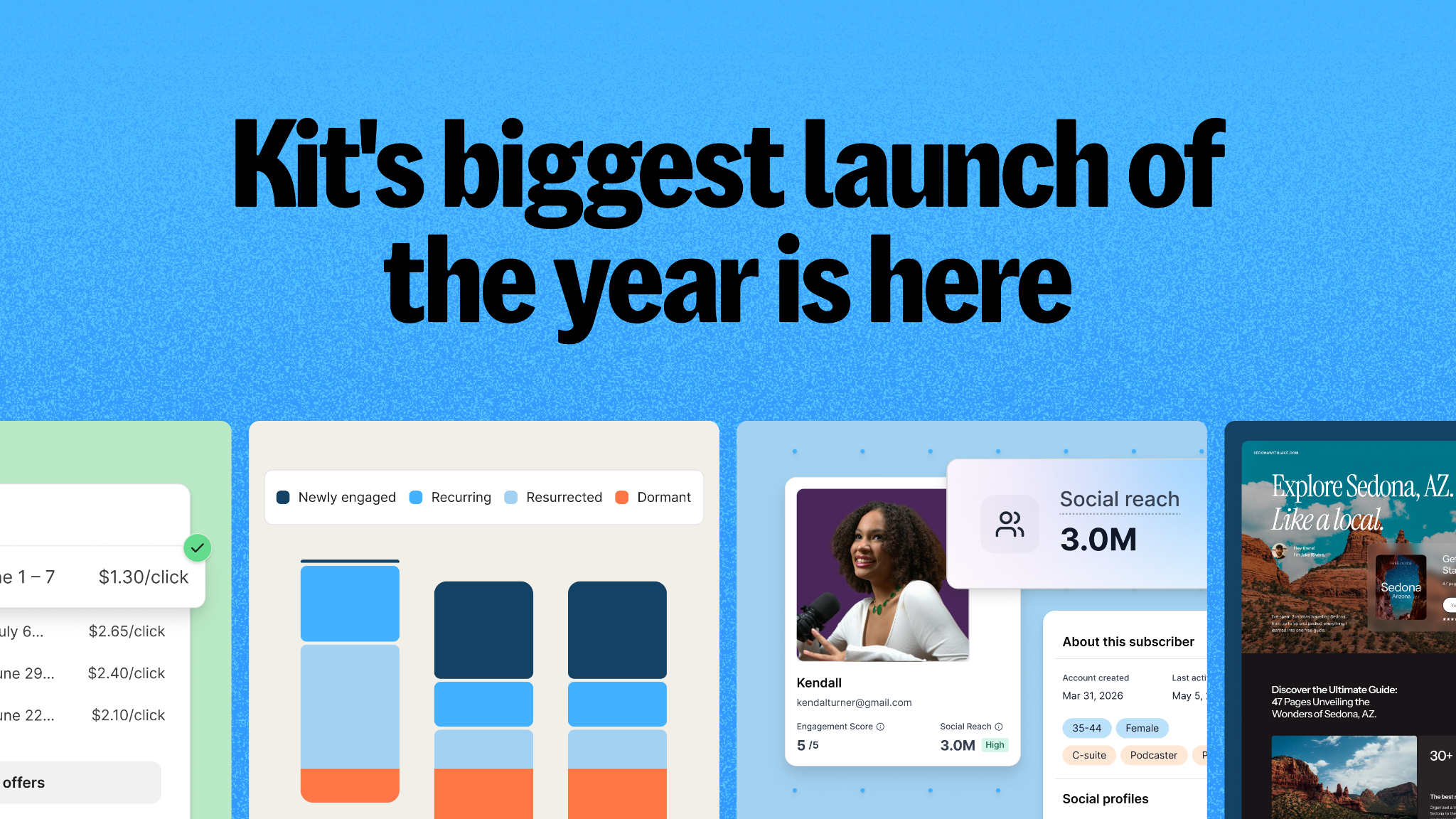
Ever sent an email blast to your entire list and wondered who actually reads it? If you’re trying to make your email marketing actually work, Kit just released an exceptional update: real subscriber intelligence. The new features they just launched make it so easy to both increase buyers on your email list AND love your audience well.
The problem with most marketing funnels is that you don’t know who your high-value subscribers are until the end of the funnel. Kit’s CEO, Nathan Barry, framed it this way: “it’s hard to love and serve people you don’t know.” Success depends not only on who you know, but who knows you, and that’s exactly what these new features are built to fix. They help you create the kind of conversations that lead to your best partnerships and your biggest launches.
The secret to conversion copywriting has always centered on voice of customer research. That means figuring out who your audience really is, what they need, and how to talk to them in a way that lands. Usually, that means hiring a smart copywriter, running surveys, or piecing together data from five different tools. Kit’s 2026 product update changes that equation by building voice of customer insights directly into the platform you’re already using to send emails.
This episode breaks down the seven features in Kit’s latest release, what each one actually does, and how coaches and creators specifically can put them to work (without duct-taping your tools together). You’ll also find answers to some of the most common questions about email marketing tips, campaign ideas, and how to actually do this well in your own list.
Subscriber Signals: Voice-of-Customer Data Built Into Your Email List
Open rates alone don’t tell you who’s worth reaching out to. Kit’s newest feature, Subscriber Signals, tells you who that person actually is with demographic context, social influence data, and purchase history on top of standard engagement metrics. This gives you a richer profile of every name on your list. Instead of guessing who’s worth a personal follow-up, you can see it quickly on an easy-to-read dashboard. You can finally see whether a subscriber is an influential industry voice, a repeat buyer, or someone who’s never opened anything, and act accordingly.
Picture a podcaster with 2,000 people on her email list, most of them collected through show notes opt-ins. Before Subscriber Signals, every name looked roughly the same in the dashboard: open, click, ignore. Now she can see which subscribers are repeat listeners who share episodes with their own audience, which ones have already purchased a course she’s promoted, and which ones signed up once and never engaged again. That distinction can show you who to personally invite to your next mastermind or group program and who may still need to be nurtured more.
A food blogger benefits the same way. Maybe a subscriber bought your cookbook and two recipe bundles but never replied to a single email. Subscriber Signals surfaces that buying behavior, so instead of sending another generic newsletter, she can reach out with something specific: like an invite to a recipe box partnership, a personal thank-you, or early access to her next launch.
Now you can personalize your subscribers’ experience through the funnel and turn it into a two-way relationship. This is also where trust starts to compound. Once you can see who your engaged buyers are, you can build the kind of relationship that grows a business with integrity. The Smart Way to Build Trust Through Email Marketing covers exactly how that works over time.
Subscriber Signals is currently in early access for Pro plan subscribers, which makes it one of the more exciting reveals to come out of Kit recently. The kind of subscriber intelligence that used to take hours of manual research and outside tools is now simply built in.
Make Profitable Decisions with Engagement Analytics
Open rates only tell you part of the story. Engagement Analytics adds cohort retention tracking, source attribution, and subscriber lifecycle health to your dashboard, so you can finally answer questions like: where do my best subscribers come from, and which ones are drifting away before they unsubscribe?
Consider a coach who guests on three different podcasts in one quarter. Without Engagement Analytics, all three appearances look like a win, since new subscribers show up after each one. With it, she might discover that subscribers from one podcast stick around, open consistently, and eventually buy, while subscribers from another barely engage past the welcome sequence. That’s the kind of insight that reshapes where she spends her time next quarter.
Podcasters can apply the same logic to referral sources. Subscribers who joined through a guest swap on another show might convert at a much higher rate than subscribers who joined through a generic lead magnet. Once that pattern is visible, marketing decisions stop being guesswork because you know where your buyers are actually coming from.
This is also where lead nurture strategy gets sharper. Knowing which subscribers are healthy and engaged, versus which ones need a re-engagement sequence, helps you build nurture flows that actually match where people are, instead of sending the same five emails to everyone regardless of where they stand.
If you want more strategy on what to actually say in these moments, Send These 5 Emails To Increase Sales With Email Marketing breaks down what to say that drives action without sounding pushy.
Engagement Analytics is currently available to Pro plan subscribers, and it’s the kind of feature that turns “I think this is working” into “I know exactly why this is working and now I can do more of what’s working.“
Use Kit’s MCP to Let AI Work Directly With Your Real Subscriber Data
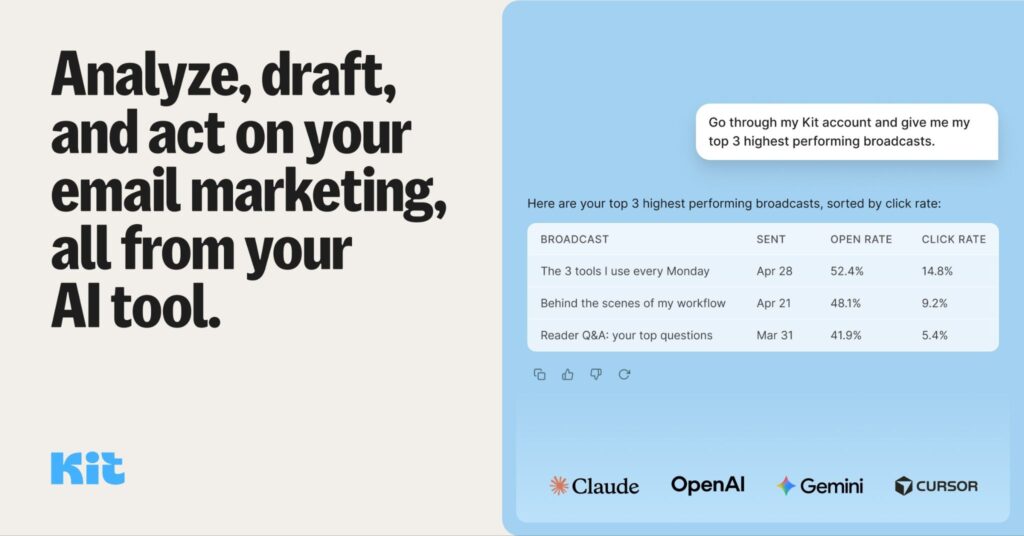
Your AI tool is only as useful as the data it can see. The Kit MCP securely connects your Kit account to the AI tool you already use, whether that’s Claude, ChatGPT, or others. Once connected, you can ask questions about your real subscriber data, draft broadcasts, tag subscribers, and take action, all from a single conversation, without switching tabs or exporting spreadsheets.
For a podcaster, this might mean asking an AI assistant to identify every subscriber tagged as a longtime listener who hasn’t opened an email in 90 days, then drafting a warm, re-engagement message in one pass. For a coach, it might mean asking AI to pull a list of everyone who clicked a specific webinar link but didn’t register, then generating a personal follow-up built around that exact behavior.
The gap most creators feel when using AI for their business is that the AI doesn’t actually know their business. It can write something that sounds fine, but it has no idea who’s on the list or what matters about them. Kit MCP closes that gap directly at the source.
It’s now out of beta and available to every paid Kit plan subscriber, at no extra cost and nothing new to learn beyond the AI tool you’re already comfortable with. This feature alone is a strong argument for switching to (or back to) Kit.
Abandoned Checkout & Newsletter Sponsorships Turn Behavior Into Revenue
Sending the same email to your entire list causes unsubscribes and lowers open rates. The best email marketers send personalized email content based on real-time subscriber behavior. This is now possible in Kit with Shopify, Fourthwall, and Wix integrations. If someone starts checkout on your course, program, or product and doesn’t finish, Kit can trigger a specific follow-up built around that exact action, rather than a generic newsletter that has nothing to do with what they were just doing.
Consider a coach selling a signature program. A subscriber adds the program to their cart, gets distracted, and closes the tab. Instead of waiting for that subscriber to show up in next week’s regular send, Abandoned Checkout can deliver one targeted nudge: a testimonial, an answer to a common objection, or simply a reminder that the cart is still there. That type of personalization used to require hiring a developer; now it can easily be done inside Kit.
A podcaster selling access to a paid subscriber community or live event ticket can use the same logic, sending a gentle, specific follow-up instead of hoping the subscriber circles back on their own.
In fact, we actually had a podcast listener and industry leader recover 20% of revenue after implementing an abandoned cart email sequence based on episode 53 “Email Sequence Tips That Actually Work”.
Newsletter Sponsorships rounds out this revenue piece by building partnership management directly into Kit. Finding, vetting, and managing sponsors usually eats up time most creators don’t have. This feature brings that workflow in-house for all paid Kit plan subscribers, so you can earn from your list without adding another task to your plate. Get started with Kit here.
Landing Pages, SMS, and the Growing Kit Ecosystem
A landing page is usually the first impression someone gets of you, so we need to get it right. Kit’s new editor gives you more control over how that page looks and feels, without needing any design background. It’s also the first step toward some bigger things on the way, like AI-assisted landing pages, built-in selling tools, and branding that stays consistent across everything you build in Kit.
Beyond landing pages, Kit’s App Store keeps expanding what the platform can do, without forcing you to duct-tape together five separate tools:
- SMS via SlickText lets you reach your most engaged subscribers directly from Kit automations, which matters most during time-sensitive launches. SMS carries a 98% open rate within the first three minutes, making it one of the fastest ways to reach someone who actually wants to hear from you.
- HubSpot CRM offers full two-way sync between your HubSpot leads and your Kit list, with CRM actions that trigger automatically based on subscriber activity (Pro plans).
- Patreon Memberships sync member tier, status, and lifetime support data into Kit, so you can trigger automations and showcase membership tiers right inside your emails.
- Event management via Luma and Eventbrite syncs registrants automatically, triggers post-event sequences, and tags subscribers by event.
A coach running a paid community can use Patreon sync to recognize and reward long-term members automatically. A podcaster hosting a live listener meetup can use SMS to send same-day reminders that fans actually see, instead of an email buried in an inbox.
All of these tools work with your email list, instead of more apps you have to manage separately.

Frequently Asked Questions
What is voice of customer research, and why does it matter for email marketing?
Voice of customer research is the process of understanding who your subscribers actually are, what they care about, and how they want to be spoken to, usually gathered through surveys, interviews, or behavioral data. In email marketing, this used to require a separate tool or research firm. Kit’s Subscriber Signals feature folds that same kind of insight directly into your existing subscriber profiles, layering demographic context and purchase history on top of standard open and click data.
How do you do email marketing well?
Doing email marketing well means treating your list as a relationship, not simply a broadcast channel. That means segmenting based on real subscriber behavior, personalizing follow-ups around what someone has actually done (like abandoning a cart or attending an event), and using engagement data to know which subscribers deserve more attention. Platforms like Kit are building these capabilities directly into the sending tool, instead of requiring a separate analytics or CRM platform.
What are some practical email marketing tips for coaches and podcasters?
Tag subscribers by behavior, not just by how they joined your list. Send abandoned checkout follow-ups instead of one generic blast to everyone. Use lifecycle and retention data to identify which content or guest appearances bring in subscribers who actually stick around. And wherever possible, automate the personal touch rather than skipping it altogether.
What are good email campaign ideas or email promotion ideas to try this year?
Strong campaign ideas right now include a behavior-triggered abandoned checkout sequence, a re-engagement campaign aimed at subscribers who haven’t opened anything in 90 days, an SMS reminder paired with a high-stakes launch email, and a sponsorship-supported newsletter edition that adds revenue without asking your audience to buy anything. For more ideas and examples of what to send, Send These 5 Emails To Increase Sales With Email Marketing is a good next read.
Create A Community That Loves To Buy From You
Every feature in this update points back to having more information to know your people so that you can default to generosity and be more creative. That’s really what voice of customer research has always been about, closing the gap between who you think your subscribers are and who they actually are. Because when they feel known, they can feel loved. And when they feel loved, they feel like they belong. And when they feel like they belong, then you have a community that will buy anything from you because they know you, like you, and trust you…all because you got to know them first.
I’ve watched this play out with real clients, not just in theory. One Power Hour client turned a single session into $6,000 from a more effective email campaign. Another client used consistent emails to 5x their email revenue (while freeing up valuable time and mental space). Neither result came from a bigger list (which is not a bad thing. But in these cases, it was not the thing that moved the needle). It came from being more intentional with who was already on it.
For coaches and podcasters especially, your work depends on relationships. Knowing which subscriber just abandoned checkout, which one is your most engaged advocate, and which one needs a different kind of follow-up isn’t just a nice-to-have. It can make a big difference in your bottom line.
If this update has you curious, dive into all of these features by joining Kit here. It’s the platform I’m recommending for service providers ready to know their list, not just mail it.
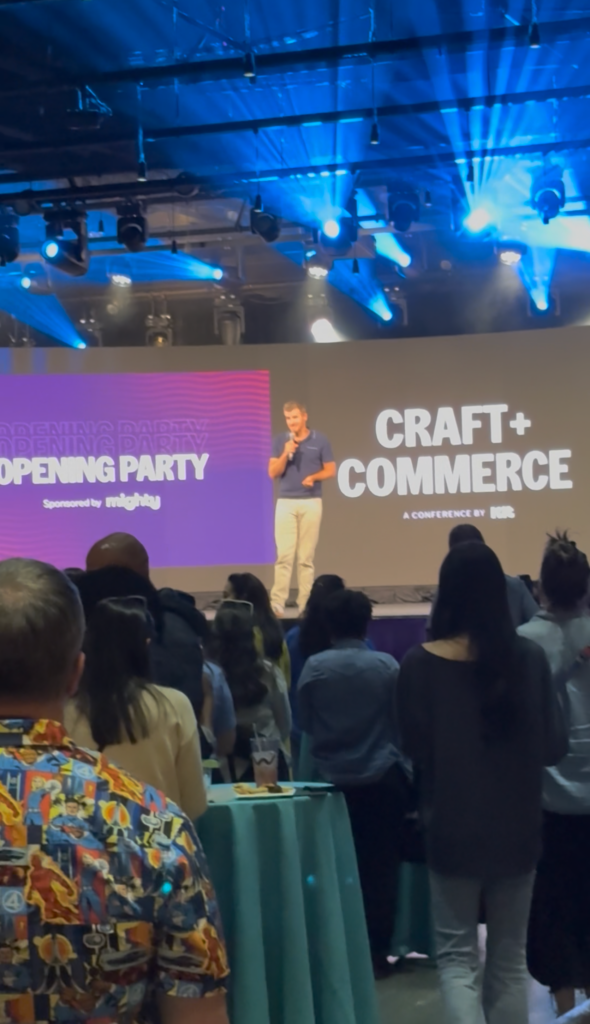
I heard about all of these updates in real time at Kit’s Craft+Commerce conference in Boise, Idaho. It’s an incredible gathering of top creators, marketers, authors, and business owners. Catch my recap of the whole conference on the blog here.
And if you want more email marketing tips like this straight into your inbox, join my email list here.
*Note: This may contain affiliate links, which means if you click and buy, I’ll earn a commission at no extra cost to you. I never recommend things I don’t love or haven’t used. 🫶